
Introduction
Many people know that vegetables such as broccoli, kale, cabbage, and Brussels sprouts are healthy, but they do not all taste the same to everyone. Some people find these vegetables slightly bitter, while others think they taste extremely bitter. Scientists believe that differences in a gene called TAS2R38 may partly explain why.
The TAS2R38 gene contains instructions for making a bitter taste receptor on the tongue. A receptor is like a sensor that detects a specific chemical and sends information to the brain. Some vegetables contain bitter compounds that activate this receptor. Researchers from the University of North Carolina and other institutions wanted to investigate the following question: Does a person's TAS2R38 bitter taste gene affect how much their vegetable intake changes after receiving nutrition counseling?
Methodology
The study included 497 adults from Lenoir County, North Carolina. They were participating in a larger program designed to help reduce the risk of cardiovascular disease, which includes heart disease and stroke. The participants were mostly middle-aged, and the study included Black and White adults.
Researchers collected blood samples from participants and used the DNA in their blood cells to examine the TAS2R38 gene. They focused on three common differences, called genetic variants, in the gene. These variants can affect how strongly a person tastes bitter chemicals.
PROP, or propylthiouracil, is a harmless chemical often used by scientists to test bitter taste. It has a bitter flavor similar to some compounds found in vegetables from the cabbage family.
The participants were placed into three bitter-taste groups:
Bitter non-tasters, who are less sensitive to a bitter chemical called PROP.
Intermediate tasters, who have medium sensitivity to bitterness.
Bitter tasters, who are more sensitive to PROP-like bitterness.
Participants were also randomly placed in one of two nutrition programs. The enhanced-intervention group received four nutrition-counseling sessions during a six-month period. They were encouraged to follow a Mediterranean-style diet and eat around seven servings of fruits and vegetables each day.
The minimum-intervention group received less intensive nutrition information. Researchers asked everyone how often they ate green salads and other vegetables at the beginning of the study and again six months later. The researchers adjusted for age, sex, race, education, income, and smoking because these factors could also influence food choices.
Results
At the start of the study, the three genetic taste groups did not have a meaningful difference in how often they ate vegetables. This means that having a bitter-taste gene did not automatically mean someone ate fewer vegetables.
After six months, however, vegetable intake changed differently among the groups. Bitter non-tasters increased their vegetable intake score by 0.65, and intermediate tasters increased it by 0.55. Bitter tasters increased their score by only 0.04. This suggests that people who experience bitterness more strongly may have a harder time increasing the number of vegetables they eat.
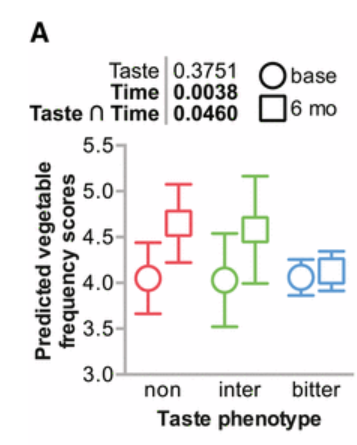
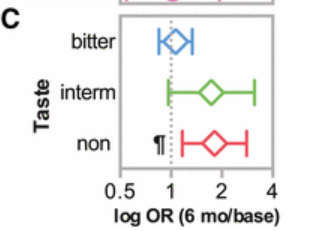
Figure 2
Vegetable intake at baseline and after 6 months categorized by TAS2R38 bitter taste phenotype. (A) Predicted vegetable intake adjusted for sex, ancestry, age, education, income, and smoking status are represented by box plot and summarized by the mean ± 95% confidence intervals at either the onset of the study (base) or at the 6-month follow up (6 mo), grouped by phenotype: bitter non-tasters (non), intermediate-bitter tasters (inter), or bitter tasters (bitter). The p values of the main effects (time and taste phenotype) and the interaction between taste phenotype and time are indicated.
The amount of nutrition counseling also mattered. Participants in the enhanced intervention group increased their vegetable-intake score by 0.58. The minimal-intervention group decreased its score by 0.19. Even people who were more sensitive to bitter taste were able to increase their vegetable intake when they received more support.
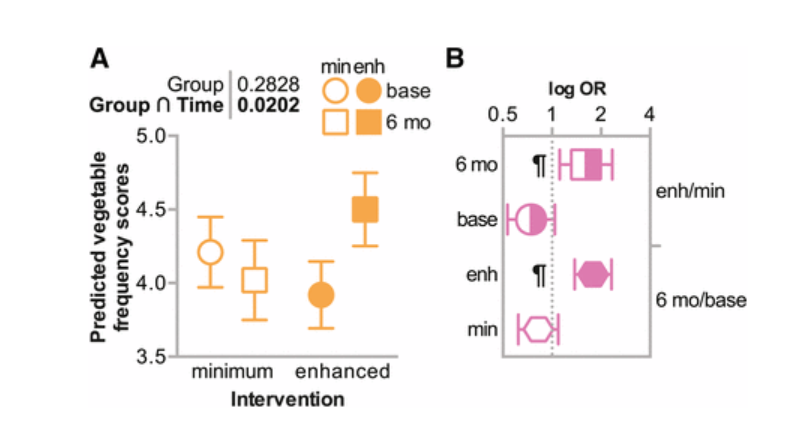
Figure 3
Vegetable intake at baseline and after 6 months categorized by intervention intensity. (A) Predicted vegetable intake adjusted for sex, ancestry, age, education, income, and smoking status are represented by box plot and summarized by the mean ± 95% confidence intervals at either the onset of the study (baseline) or at the 6-month follow up, grouped into the minimal (min) or enhanced (enhanced) intervention group. The p values of the main effect (group) or the interaction between intervention intensity and time are indicated. (B) The log odds ratios (OR) of vegetable intake comparing the enhanced vs. minimum intervention at either 6 months or baseline (top) or at 6 months vs. baseline in either the enhanced or minimal intervention (bottom) are represented by box plot and summarized by the mean ± 95% confidence intervals: indicates the ratios where the 95% confidence interval does not contain the value of 1.
Conclusion
This study suggests that genetics may influence how easily someone changes their vegetable-eating habits. People with genetic variants linked to stronger bitter taste increased their vegetable intake less than people who were less sensitive to bitterness.
However, the TAS2R38 gene does not decide whether someone will like vegetables. Food preferences are also influenced by family habits, culture, money, cooking methods, and how often someone has tried a food. A person may dislike raw broccoli but enjoy roasted broccoli, broccoli in pasta, or broccoli with a sauce they like6.
This study also has limitations. It included adults rather than teens, so the same results may not apply exactly to younger people. Participants reported how often they ate vegetables, which may not perfectly match what they actually ate. The study also measured how frequently people ate vegetables rather than the exact amount.
Although the study has interesting results, more research should investigate teenagers and test whether different cooking methods or repeated exposure to vegetables can help bitter tasters enjoy healthy foods more often.