
Introduction
Have you ever wondered how public speakers appeal to their audiences? Well, effective communication depends on shared cognitive processes. Public speakers using traditional methods to communicate with their audiences fail to note if their audiences are engaged. Throughout this study, researchers wanted to see if engaging public speeches create a higher synchronization pattern among the listeners who are present to see the public speaker.
Methods
Participants who were native Mandarin speakers watched educational speeches while going through fMRI brain scans. The team of researchers used ISC (Inter-Subject Correlation), or, in other words, a Neuroscience analysis method that measures how different people react to shared experiences, to measure how participants reacted when it came to speeches with low engagement compared to those that had higher engagement.
Results and Images
The speech that was the most engaging triggered a stronger neural synchronization among the participants, particularly in the regions of the brain dedicated to the processing of language and understanding others’ perspectives. Although researchers did note a downside that public speakers were using traditional methods to appeal to their audiences, they did not give clear advice on what public speakers should do regarding it.
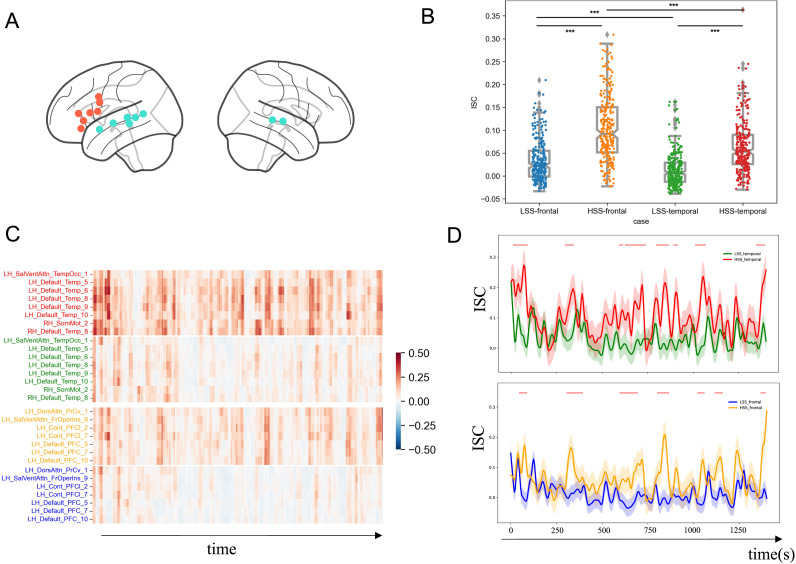
This image shows the fMRI scans taken of the participants and how their interest levels fluctuate with the speeches that they were exposed to. Figure A shows the interest levels that were present in the Frontal and Temporal cortex regions. Figure B compares and contrasts the levels of interest in the participants' brains, ultimately showing higher levels of interest within the audience. Figure C shows how the ISC levels within the participants are fluctuating as they are witnessing the speech. And lastly, Figure D shows their ISC levels over time with the speeches that they were watching.
Limitations
The study relied on a small sample size of young adult native Mandarin speakers watching a pre-recorded speech rather than witnessing a live event of a speaker.
Conclusion
Public speaking that is engaging would connect the audience on the same wavelength by using language that would resonate or connect with the audience in some shape or form.