Introduction
When you take notes for class, do you reach for a notebook or open your laptop? Typing can help you get words down quickly, while writing by hand makes you form each letter. Those actions feel different, but do they also produce different activity in the brain?
Researchers F. R. Van der Weel and Audrey Van der Meer explored that question in a study published in Frontiers in Psychology. They compared brain activity while university students wrote words with a digital pen and while they typed the same words on a keyboard. The researchers were especially interested in functional connectivity, how closely activity in different parts of the brain follows the same pattern during a task.
Methodology
Forty university students in their early twenties joined the study. The researchers used recordings from 36 of them because those recordings were clear enough to analyze. All participants were right-handed, which helped the researchers keep handedness from complicating the comparison.
Each student saw 15 familiar words on a screen. They completed two tasks with those words: writing them in cursive with a digital pen on a touchscreen and typing them on a keyboard. The tasks appeared in a mixed order. To keep the typing movement consistent, students used only their right index finger rather than typing normally with both hands. Each task lasted 25 seconds, although the researchers analyzed only the first five seconds of brain activity.
While students worked, they wore a cap with 256 sensors. The cap used electroencephalography, or EEG, to record electrical activity from the scalp. Researchers cleaned the recordings to reduce interference from movement, then compared how strongly activity in different brain areas was linked during handwriting and typing.
Results
The researchers found stronger functional connectivity during handwriting than during the one-finger typing task. The main difference appeared in theta and alpha rhythms, especially among areas near the top and middle of the brain. Their analysis identified 16 significant connections that were stronger during handwriting.
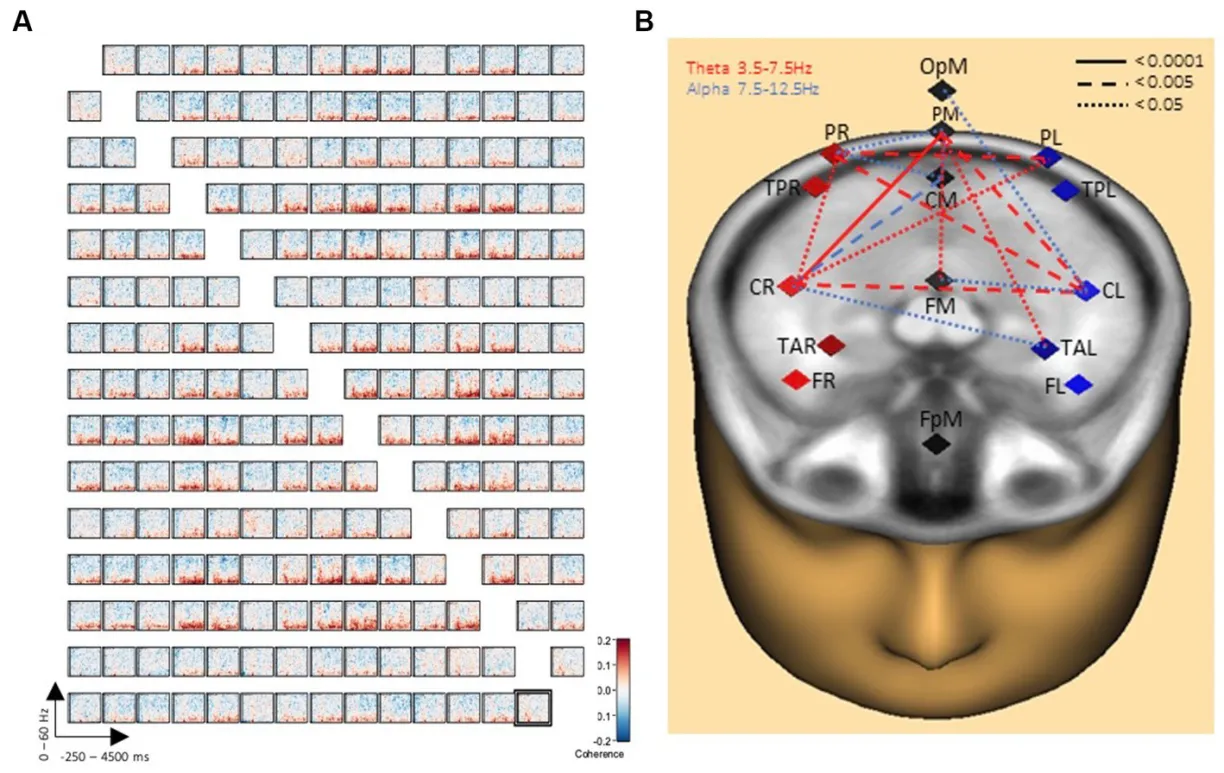
Figure 3. Brain connections that were significantly stronger while participants wrote by hand than while they typed with one finger. Red lines show connections in the theta frequency range; blue lines show connections in the alpha range. Adapted from Figure 3B in Van der Weel and Van der Meer (2024).
Why might the tasks differ? Writing a word by hand requires the student to guide the pen through a series of shapes while watching the letters appear. Pressing a key produces a whole letter with one movement. The researchers suggested that the combination of movement, vision, and awareness of hand position during handwriting may help explain the brain activity pattern they observed. Their study, however, did not isolate which part of that experience caused the difference.
The result is interesting, but it needs careful interpretation. Stronger connectivity did not mean that the students remembered the words better. The students copied words they already knew, and the researchers did not test what they learned or remembered afterward. The study measured brain activity during writing, not learning performance.
Limitations and Conclusion
One important limitation is that the typing task was unlike the wya most people type notes. Students used one finger, and their typed words did not appear on the screen. During handwriting, they could see the letters they made. The differences may have affected the brain recordings, so the experiment cannot tell us exactly what would happen when someone types normally in class. Researchers commenting on the study have highlighted these concerns.
The study also involved 36 university students whose recordings could be analyzed, not teenagers in a classroom. It did not compare grades, note quality, or memory-test scores. That means it would be too strong to conclude from this experiment alone that every student should stop typing and take all notes by hand.
The study does show that handwriting and this particular typing task were associated with different patterns of brain activity. A useful next step would be to let students type normally with both hands, give both groups the same visual feedback, and then test how much new information they remember. Until then, the study offers a question worth exploring, not a final answer about the best way to take notes.