
Introduction:
What does being an extrovert mean? In the scientific world, the term extrovert is referred to as extraversion, a fundamental personality dimension. Extraverts prefer engaging, seeking, and enjoying social interactions, while introverts tend to avoid social settings. Research shows that extraversion is associated with neural activity involving dopamine. The question to be addressed however is whether extraverts' neural circuits are more sensitive to social stimuli. Scientists therefore need to establish whether social stimuli actually create different effects in the brains of extraverts compared to introverts.
Event-related potentials (ERPs) are a measure used to assess brain activity. These are captured by averaging EEG signals to get short reflections of brain activity. More specifically the P300 component is used to measure brain activity. This is a known marker for measuring activity after stimuli, especially individual-specific experiences as shown in experiments where pictures of babies and male models evoked larger P300s in high-progesterone phases as compared to women in low-progesterone phases and experiments involving alcohol use. This leads us to the theory that the P300 amplitude may reflect information that is motivationally significant or subjectively important.
Thus, the study utilizes these P300 amplitudes to test the hypothesis of whether or not extraverts show increased P300 amplitudes when human faces are shown as stimuli, compared to other nonsocial stimuli. This allows scientists to figure out whether neural circuitry in extraverts is more sensitive to processing information with social content than introverts.
Method:
Thirteen males and fifteen females between the ages of 18 to 40 and representing a diverse race mix participated in this study. They were recruited out of a multicenter research program with no history of central nervous system disorder or injury. Individual extraversion was assessed using a 48-item Extraversion scale of the NEO Personality Inventory Revised.
An "oddball" task was used to measure attention allocation to social images among the extraverts. There are blocks of social events with human faces and nonsocial blocks of events with pictures of flowers. There were no consecutive trials to avoid sequential effects that can obscure differences between target and nontarget.
There were four blocks of 60 trials each. The data were cleaned for background noise and eye blinks and movements. The clean target trials were used for analysis.
In data analysis, this study employed a statistical method called Principal Components Analysis (PCA) in order to isolate and measure the P300 amplitude. They wanted to use correlation analysis to deduce the results of their experiment as extraversion is a continuous spectrum rather than discrete. The specifics of the methodology are beyond the scope of this article, so readers interested in the details are encouraged to refer to the original scientific paper.
Results
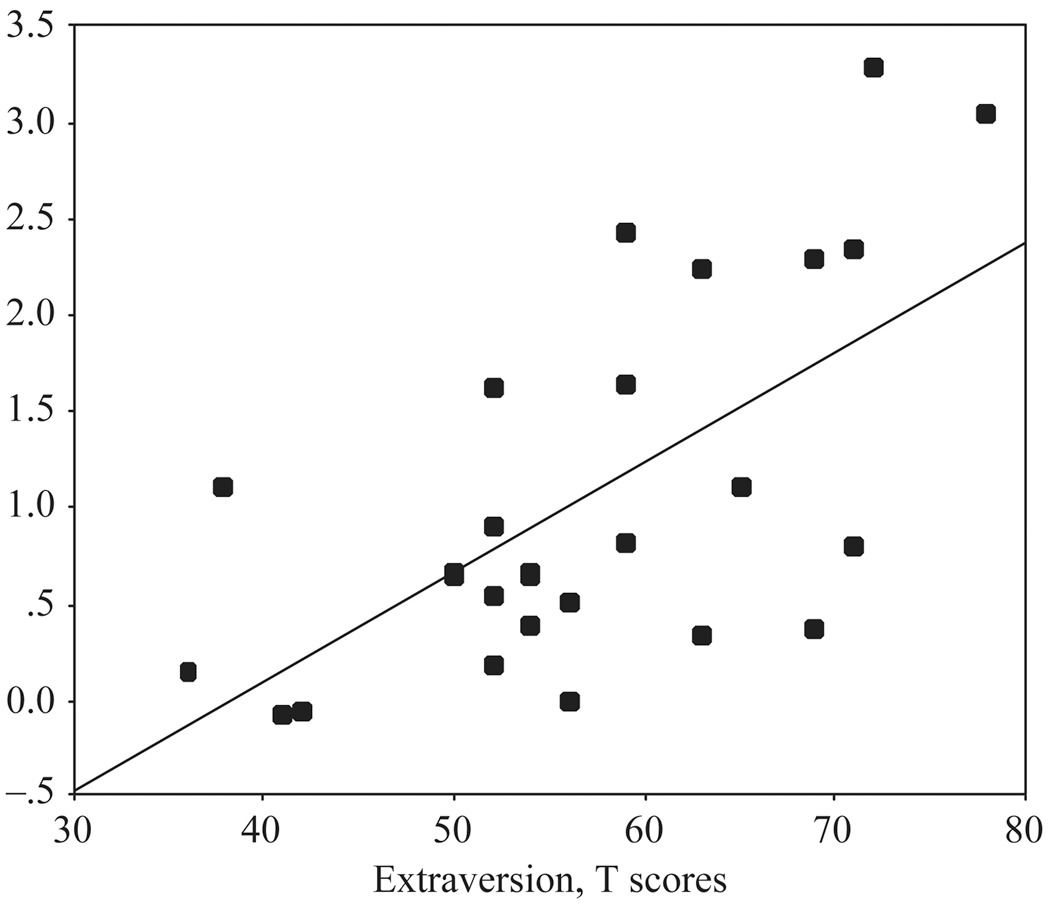
Extraversion is measured by the scale to be a wide spectrum with no significant correlation to age or education. The study found that extravert brains produce a significantly higher P300 response to faces than introvert brains (Figure 1). Participants responded relatively similarly to flowers regardless of their level of extraversion. The reliability of these results was supported by the absence of outliers, stable results, and no correlation with age.
Figure 1. Extracted directly from scientific article
Discussion:
The main finding of this study is that the variation of Extraversion is strongly associated with the extent to which social stimuli evoke enhanced allocation of attention. The higher the score on extraversion, the higher the index of P300 to oddball targets. Faces in turn have strong significance and neural activity for individuals with high extraversion. This also highlights the importance of faces to human being in general. For introverts however, this is not the case with low attention allocation when presented with faces. A causal relationship cannot be inferred at this point, however, these findings strongly suggests a possible connection. Since the P300 brain signal was used to measure activity, it is possible that the LC-NE system (Locus Coeruleus-Norepinephrine system) may help explain the mechanisms underlying behavioral differences between introverts and extraverts.