Introduction
In patients with advanced lung cancer, sleep disturbances and associated symptoms are chronic. While a recent analysis found that exercise can improve sleep quality, this was only applicable to those with early-stage cancer. This randomized clinical trial examines the comparative effects of aerobic exercise (AE) and tai chi (TC) on the sleep quality of patients with lung cancer. It is hypothesized that the patients in the AE and TC groups will show an improvement in sleep quality in comparison with the control group (CG).
Method
This study was a randomized clinical trial and was assessor-blinded, comparing AE, TC, and a CG with ethical approval addressed (see original article). 226 patients who were all over 18, had advanced lung cancer, and did not already exercise intensively were selected. Applicants were randomly chosen from 3 public hospitals in Hong Kong and were randomly distributed into AE, TC, or the CG at a 1:1:1 ratio.
The AE group received two 60-minute supervised exercise sessions and home-based exercises per month(8 sessions total over 16 weeks). The AE group had exercises such as stationary biking, treadmill walking, and basic muscle-strengthening exercises with resistance bands. The TC group received 60-minute group sessions twice weekly, based on meditations and a 16-form Yang style of Tai Chi, which was taught by an experienced TC master. The CG received clear physical activity guidelines.
Results and Limitations
Data were collected at baseline, post-intervention (16 weeks), and 8 months post-intervention. The primary endpoint was subjective sleep quality, assessed through self-report questionnaires; the secondary endpoints were fatigue, psychological distress, quality of life, physical function, objective sleep parameters, etc.
Of the enrolled participants, 75 were assigned to AE, 76 to TC, and 75 to CG. Below is the full flowchart, including the conditions of all participants.
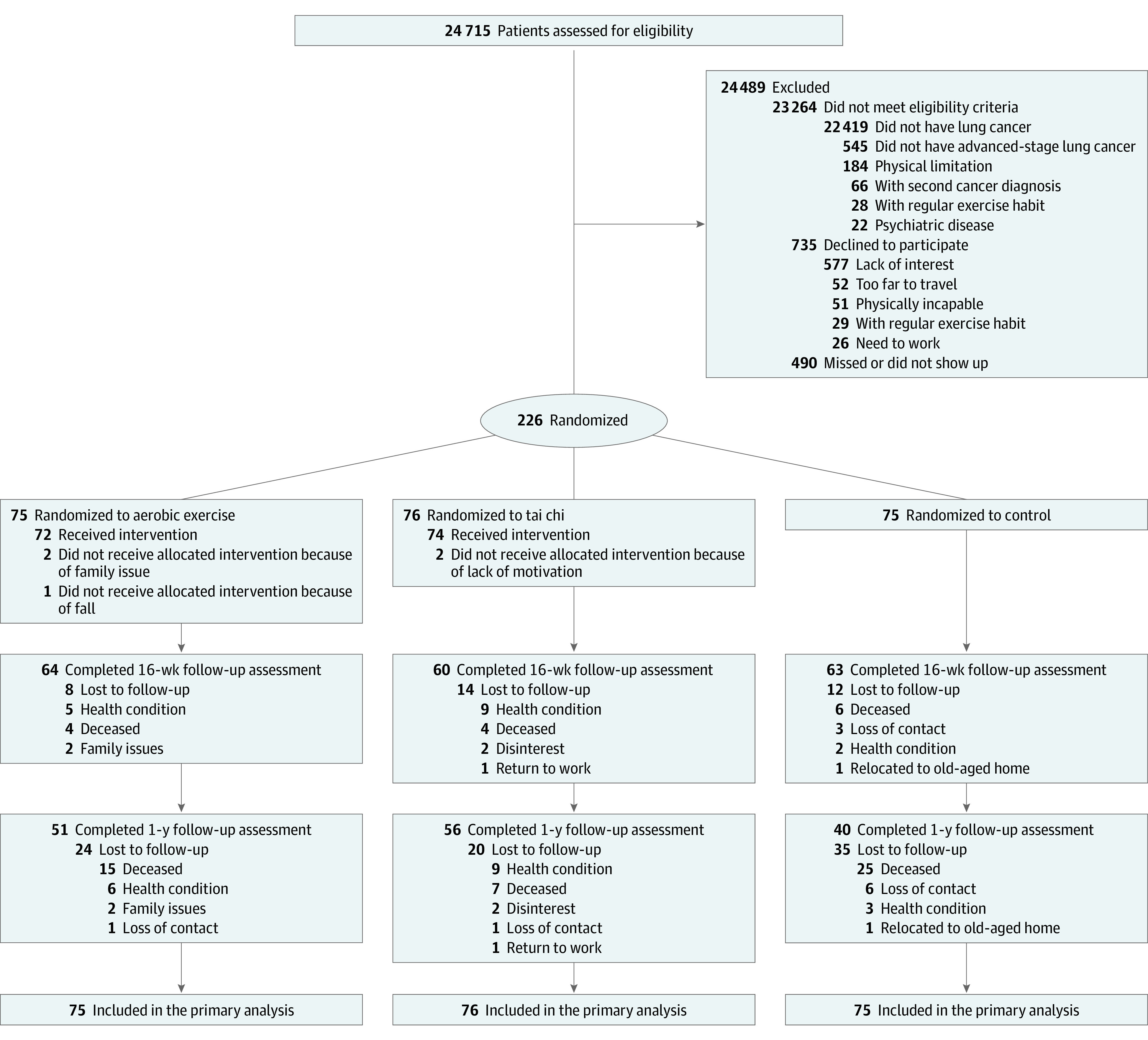
Figure 1: CONSORT flow diagram
Results
There was a statistically significant greater reduction in Pittsburgh Sleep Quality Index (PSQI) in both the AE and TC groups compared with the CG at the first term. The TC group showed a statistically significantly greater reduction in PSQI than the AE group at both terms.
Secondary endpoints also show that the TC group had a statistically significantly lower fatigue score, longer survival time, better balance, and better scores in the walk test and sit-to-stand test. It is also worth noting that the TC group had a significantly lower hazard ratio (0.35 or a 65% reduction in risk of death compared to the control group), even compared to AE(0.55), showing a possible link between Tai Chi and higher rates of survival among patients with advanced lung cancer.
Limitations
Limitations of this study include expectation bias, as participants were aware of the group assignment and requirements of self-practice, which may not have been accurate. There was also a potential for patients with greater determination to change their lifestyle or with less symptom burden to have a higher tendency to participate. These all limit the generalizability of this study. Moreover, self-reports were subjective and may have included social desirability bias.
In addition to this is the loss of people before the 16-week assessment and the one-year assessment. Many people were lost to follow-up for a multitude of reasons(death, family issues, loss of contact), which lowered the number of people who participated and reported their findings to the study, leading to decreased accuracy in the results.
Conclusion
In this clinical study, among participants with advanced lung cancer, AE and TC resulted in statistically significant improvements in sleep quality. Particularly, the TC group showed greater improvement in sleep than those in the AE group. Not only this, but Tai Chi also tends to have lower mortality rates than other groups, suggesting benefits beyond just sleep quality. Thus, it could be concluded that Tai Chi and aerobic exercise could contribute to the well-being of patients with advanced lung cancer. As the search for more advanced cancer treatments increases, tai chi, especially, could be a potential supplement for patients with advanced lung cancer to improve sleep quality and survival rates.