Introduction
"Breakfast is the most important meal of the day" is a phrase that gets commonly thrown around. But how important is breakfast, really? Would skipping breakfast be an effective way to lose fat, and would there be any difference if you simply tried to make up the lost calories later? How about how breakfast affects athletic performance? This study seeks to answer these questions, and more clearly define the connection between eating breakfast, exercise, and energy consumption. It seeks to make links between how eating and not eating breakfast affects our behavior later in the day, both paired with and without exercise.
Methodology
The study recruited 12 young, fit men from Bath that ranged from 20 to 26. The participants were all tested under the following conditions: BR (breakfast and then rest), BE (breakfast followed by exercise), and FE (fasting followed by exercise). Each participant was tested under all 3 sets of conditions, but the order was randomized for each participant to eliminate the chance of effects that may result purely because of the order of the three conditions. When participants came for the trial, a baseline blood sample was drawn, and a urine sample was taken. The BR and BE groups were provided a breakfast consisting of oats and milk, providing a total of 431 calories of energy. Participants were instructed to eat until they were full or finished the meal. All groups were then allowed 2 hours of rest, during which 5-minute expired gas samples were taken each hour. The FE and BE groups began an hour of cycling on bicycle machines with ergometers attached, during which expired gas samples were taken every 15 minutes (measured for two minutes) and blood was sampled at 40 and 50 min of exercise (at the respective times for resting for the BR group). Muscle biopsies were taken, and a 2 hour OGTT was performed on all groups. During the OGTT, blood samples were taken every 10 minutes, and an expired gas sample every hour. The participants in all groups were provided lunch, consisting of oats, whole milk, maltodextrin, whey protein isolate, olive oil, and water. Unlike the provided breakfast which was carefully weighed out to be the same for everyone, the participants were provided lunch until they said they were "comfortably full". Thus began the free-living, where the participants were provided food to take home to eat for the rest of the day, including a pasta meal, (containing pasta, tomato sauce, cheddar cheese, and olive oil), four 35-g snack bars, and two 180-mL chocolate milk flavor drinks. The participants were instructed to bring all food not eaten back to the lab the next day, so the remaining amount could be subtracted to find the amount of food that they had consumed. They were also each given an Actiheart monitor, which measured the amount of physical activity they performed outside of the laboratory. This entire setup would be repeated a total of three times, with participants being in a different conditional group each time.
Using the VO2 and VCO2 from the expired gas samples, the researchers used indirect calorimetry to calculate energy expenditure and substrate utilization. Using the urea concentrations in the urea sample, the researchers could estimate nitrogen excretion and thus calculate protein utilization. Plasma leptin and fibroblast growth factor 21 concentrations of the blood samples were also taken.
Results
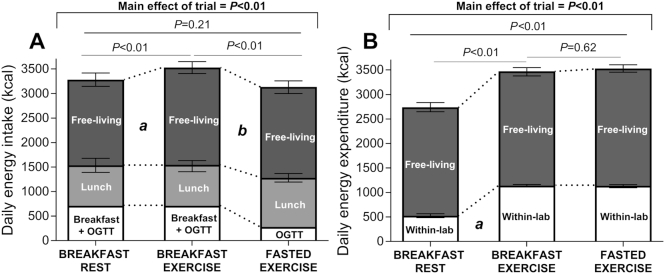
Figure 2.
The table above shows the energy intake and expenditure of the participants. The OGTT adds to the daily energy intake since the test requires a 75 g glucose drink to be ingested. Significantly, there is not a large increase in the amount of food eaten during lunch and the free-living period.
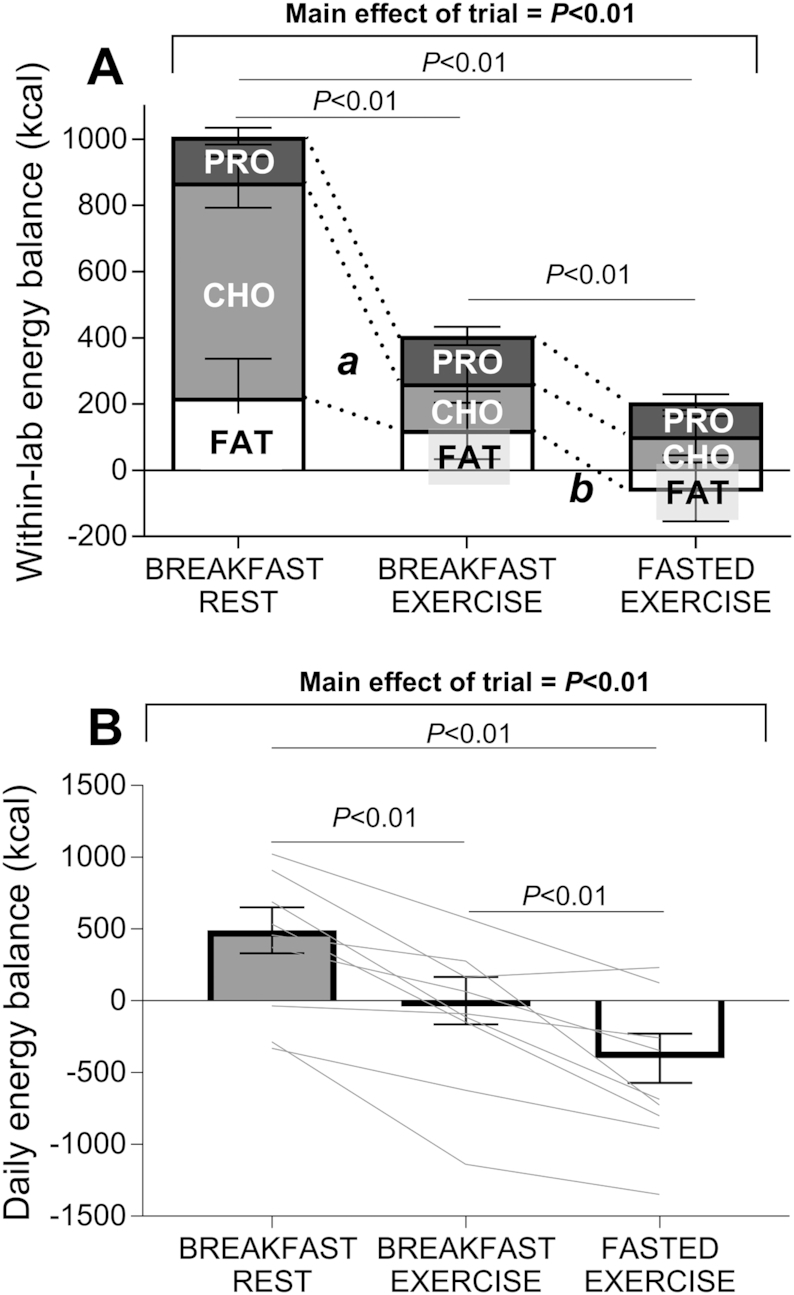
Figure 4.
The first graph shows the energy balance of each macromolecule, calculated as calorie intake minus used calories. The second part shows the overall energy difference after the entire day, using the BE group as a baseline. Most critically, the fasted exercise group saw a large drop in fat energy balance. The protein and carbohydrate balances did not see as significant of a drop from BE to FE as fat did. This implies that the reason for the decreased fat energy balance is purely a result of the fasting.
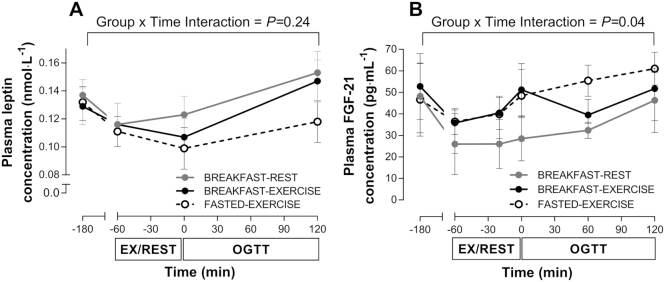
Figure 5.
The figure shows levels of plasma leptin (an indicator of fat levels) and FGF-21 (a hormone that promotes the conversion of fat into energy). Notably, the FE group has significantly lower plasma leptin than the BE group, and significantly higher FGF-21 after the OGTT began.
Conclusion
The lack of significant difference in energy intake at lunch and during the free-living period shows that if you skip breakfast, you tend to not make up the calories later in the day and simply have a calorie deficit instead. The data about the energy balances shows that fasting makes the body use more fat than usual during exercise after fasting. So as a whole, if you skip breakfast, you will tend to eat less calories that day and use more fat during short-term exercise. Energy deficits can be helpful for some people towards weight loss, and omitting breakfast may potentially lead to short term energy deficit.
Some limitations of the study include the demographic. Only young, fit men were targeted, and it's unclear if the same trends would hold true in other groups of people. Furthermore, the food given to participants was specifically picked out, and perhaps different results would follow if different foods were given.