
Introduction
Sleep itself is a universal constant and is a key factor in recovery and physiological growth. In some parts of the world, over 80% of children in preschool (aged between 3 and 6) attend an ECEC (Early Childhood Education and Care) service. A similar aspect of the ECEC programs is enforced sleep schedules.
During this time of their life, a child will shift from biphasic sleep to monophasic sleep. This shift demonstrates a developmental trajectory in the growth and maturation of a child. However, there are often differences in the struggles between children as they shift away from habitual napping. In ECEC programs, however, this is usually not well accommodated. This can lead to discrepancies in the necessary sleep for a child. During mandated sleep times, some children often react poorly, refusing to sleep and causing disruptions. It is unclear whether or not there is a correlation between these issues and nighttime sleep issues. However, two interpretations of this issue arise. One comes from the simple explanation of underlying behavioral problems or a sleep-specific time behavioral disposition. The other question is whether this issue comes from a natural shift of the child to a monophasic sleep pattern.
Methods
Here, the data were collected to be used as part of another larger prospective cohort study called the Effective Early Education Experiences (E4Kids) study in Australia, which is about finding the effects of early care and education on the long-term development of children. The effects of early childhood care were measured on long-term development in an Australian sample of early childhood program provisions. At the time, 239 potential children for the study were still in their childcare programs. However, due to restrictions such as a lack of parent report data, differing age ranges, no scheduled rest time, missing data, or relevant study variables, a portion of the subjects were removed. The final count was 158 children with an average age of 58.89 months(about 5 years old) and a range of 49-72 months(about 4-6 years old). Another note is that the subjects were a majority male, with 86 males to 72 females.
The study measured several factors that might influence trouble sleeping during naptime, including nighttime sleep duration via a parental report, cognitive functioning using the Woodcock-Johnson III, and a Brief Intellectual Ability(BIA) scale, which was calculated for each child by averaging the three WJIII subscales: verbal comprehension, concept formation, and visual matching. Socioeconomic status was also taken into account, using parental education as a proxy.
Behavior was also measured on an SDQ (Strengths and Difficulties Questionnaire) that covered behavioral screening and emotional problems, 5 domains of child behavior, regarding emotional symptoms, conduct problems, hyperactivity, peer relationship problems, and prosocial behavior. These were then separated into internalizing(issues with emotions and sociability) and externalizing(conduct problems and hyperactivity). Child temperament was also measured on the STSC (Short Temperament Scale for Children), which measured the sociability, persistence, and inflexibility of a child to agree, essentially a measure of a child's maturity. Both surveys were completed by a parent.
Children were classified into one of four groups based on napping behavior and teacher ratings. Subjective interpretation was used. The groups were "nappers"(44 children), "transitioners" (41 children; for the transition between monophasic and biphasic sleep hypothesized), "resters"(48 children), and "problem nappers" (25 children).
Results
Essentially, the variables that could be affecting the nap time were separated into three functions based on importance. Researchers found that functions 1 and 2 were the most significant, which meant that these two variables created clear distinctions between groups.
Function 1, the most important, represents developmental maturity, taking into account the sleep duration(not during naptime), intelligence based on the BIA scale, and age. This proved that brain development/age is the most important factor in napping.
Function 2, Socioeconomic status, was measured in parents' education and reflected the family background of the child. This also showed a high correlation with napping, most likely due to the effects of a family environment on brain development, sleep routines, and behavioral patterns.
Function 3 was the least significant by far, with it representing temperament and internalizing and externalizing behavior, measured by the SDQ and STSC. This meant that napping and sleeping had little to no correlation to behavioral/emotional issues in young children.
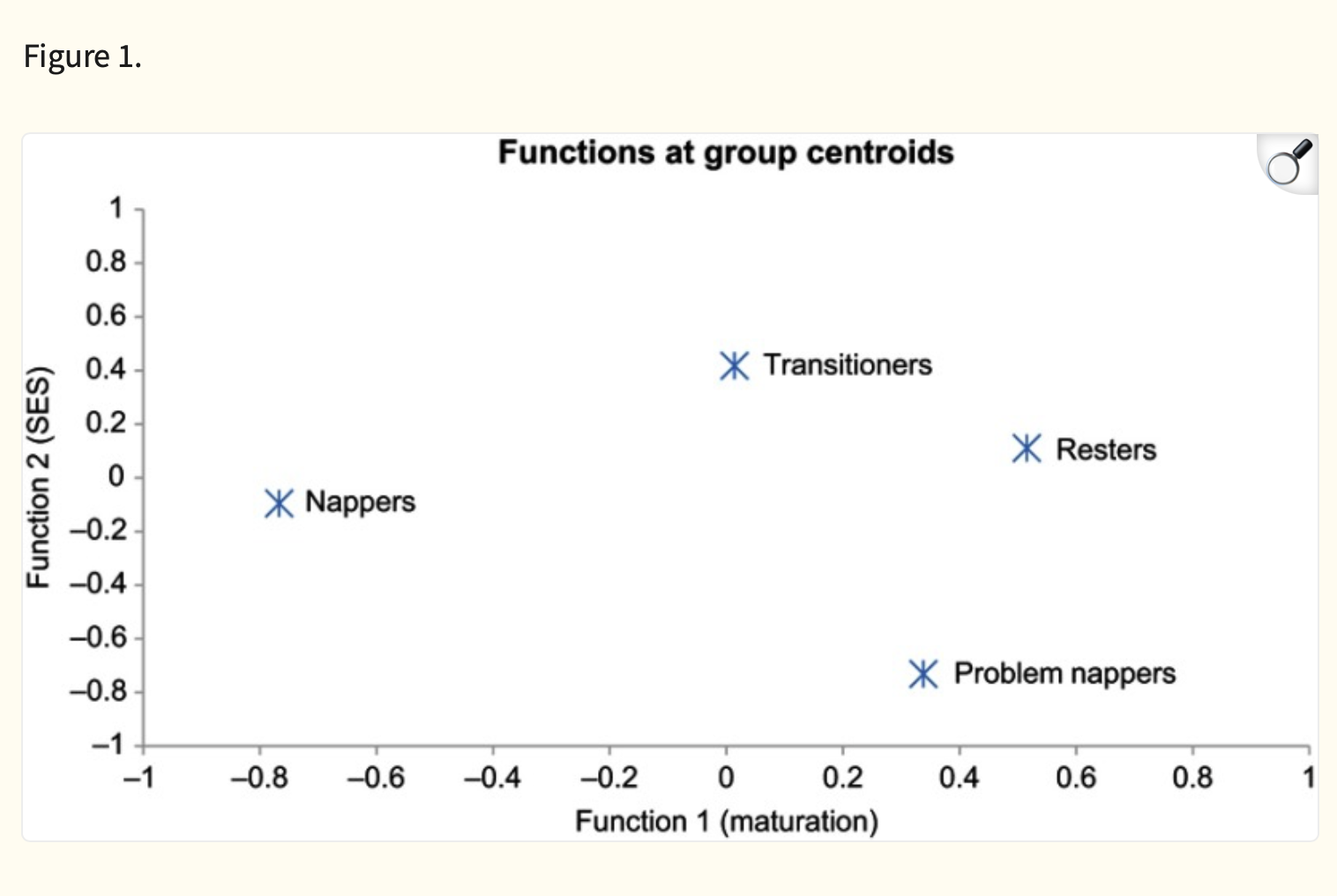
Shown above in Figure 1 is that overall, over half of the original cases were correctly classified using functions 1 and 2. The model has a good degree of accuracy, with 63.6% of nappers, 36.6% of transitions, 66.7% of resters, and 32% of problem nappers being correctly identified. As a whole, this shows the functions that were most important in classifying the children. Some limitations of this study include parental and teacher miscommunication or bias. Due to the high amount of parent and teacher reporting, many things are likely to be untrue or slightly off, and although this does not jeopardize the validity of the study, it is something to keep in mind. Underlying conditions in any of the children studied could also very well play a role. Another factor is that the students were in one area, in localized environments, which likely also plays a role.
Conclusion
Essentially, the most prominent factors with trouble napping were due to maturity and socioeconomic factors, rather than behavioral problems. With only 30% of observed children sleeping during nap time, we can confidently say that the shift away from napping is highlighted by a developmental change in sleep. Transition of sleep is a very important milestone and needs to be responsive to patterns in children who are developing. The children who showed problems were only exhibiting those problems at nap time. In addition, the classification of transitioners shows the phase of toddlers transitioning to sleep patterns. The impact of parental education on problem nappers also highlights a demographic influence on sleep. Other studies in the early years should be conducted to measure developmental conditions and dimensions in widespread populations to confirm these findings.
