
Introduction
Antibiotics have revolutionized modern medicine and allowed physicians to treat previously lethal bacterial infections. Nevertheless, bacteria constantly evolve, and some become resistant to antibiotics. An example of such bacteria is the methicillin-resistant Staphylococcus aureus (MRSA).
As it is difficult to treat MRSA infections because of antibiotic resistance, it is becoming increasingly difficult to find alternatives that would not simply be based on the use of yet another antibiotic.
In particular, researchers began to explore virus therapy as an alternative.
Phages, or bacteriophages, are viruses capable of infecting bacteria. Phages reproduce within the bacteria that they infect and then kill the bacteria. Scientists began to explore the potential of using phage therapy as an alternative to treating antibiotic-resistant bacteria.
There is one difficulty associated with phage therapy.
It was discovered in a 2025 study carried out at the University of Wisconsin-Madison that when MRSA survives a bacteriophage infection, it becomes resistant to the phage but also more susceptible to antibiotics.
Methods
Three MRSA strains, namely MRSA252, MW2, and LAC, were analyzed by the researchers. All these strains were subjected to ΦStaph1N, which succeeded in infecting the bacteria.
After being exposed to the bacteriophage, most of the bacteria that were susceptible to infection died. But some bacteria survived, allowing them to reproduce and form new populations capable of resisting phages.
The initial MRSA bacteria were then compared with phage-resistant populations. It was checked how well they resisted several β-lactam antibiotics such as oxacillin, cefazolin, and amoxicillin together with clavulanic acid.
To assess resistance to antibiotics, MIC (minimum inhibitory concentration) was calculated. The lower the MIC, the less of the drug is necessary to inhibit bacterial growth. Thus, the drop in MIC shows the increase in bacterial sensitivity to antibiotics.
Figure 1:
How Phage Exposure Changed the Bacterial Population
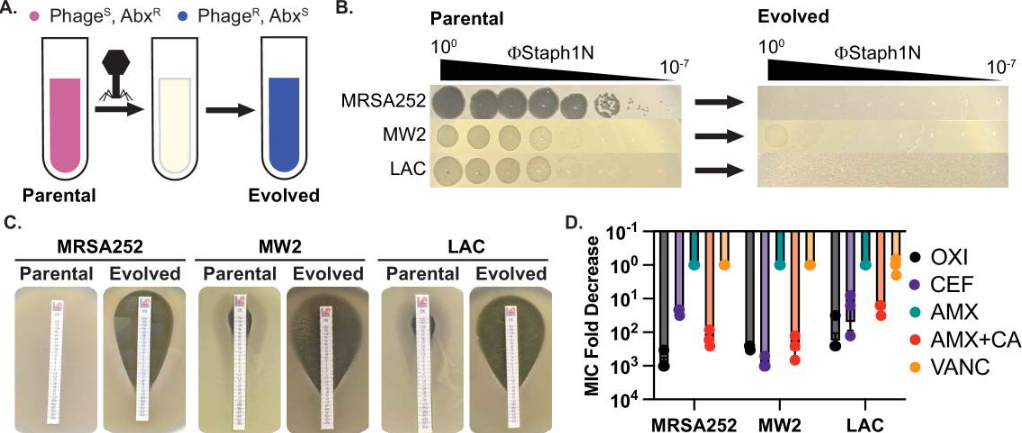
Figure 1.
Experimental set-up where the populations of MRSA were subjected to exposure to bacteriophage ΦStaph1N, and the survivors were isolated and subjected to analysis of their resistance to the phage and antibiotic.
This process basically amounted to an evolutionary selection challenge faced by the bacteria. In order to reproduce, the bacteria needed to survive the phage exposure, and this allowed researchers to study what traits prevailed among the survivors.
Results
It turns out that the results indicated an interesting trade-off.
The MRSA bacteria that survived the infection of ΦStaph1N became resistant to this particular phage. However, this newfound resistance was coupled with a drawback: namely, the bacteria experienced a drastic reduction in their resistance to various β-lactam antibiotics.
In some cases, the resistant populations exhibited minimum inhibitory concentrations 10- to 1,000-fold lower than before.
Figure 2:
Phage Resistance Can Increase Antibiotic Sensitivity

Figure 2. Changes in antibiotic susceptibility following phage treatment. The decrease in MIC indicates that MRSA, which was resistant to phages, became more susceptible to various β-lactams antibiotics.
This effect was particularly evident in antibiotics such as oxacillin, cefazolin, and a combination of amoxicillin and clavulanic acid. It should be noted that all antibiotics exhibited such an effect, but vancomycin did not.
The latter fact is very interesting because it indicates that the phage resistance development mechanism does not include general weakening of the bacteria but consists of changes in specific parts of bacteria, allowing them to withstand the action of the phage and become susceptible to the action of various antibiotics.
To better understand the process of phage resistance development, the scientists conducted genetic analysis of the samples. In the course of genetic analysis, various mutations were revealed in MRSA populations exposed to the action of phages.
Several of these mutations were related to the bacterial cell wall.
Figure 3:
An Evolutionary Trade-Off
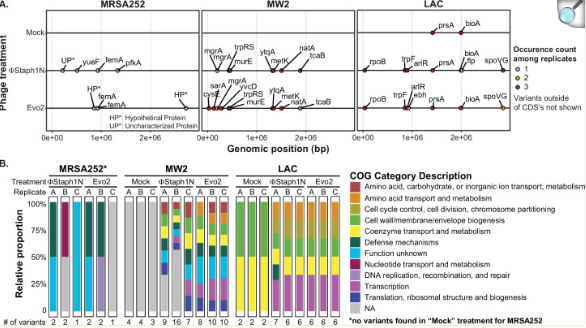
Figure 3. Proposed evolutionary trade-off in MRSA. Mutations that allow bacteria to avoid bacteriophage infection can interfere with processes involved in β-lactam antibiotic resistance.
This presents an intriguing case of an evolutionary trade-off. The bacteria can get the upper hand over one type of threat, but will lose it on the other type.
In the described example, surviving the phage attack can involve bacterial mutations that disrupt some of the processes that lead to antibiotic resistance. In this way, phage resistance and antibiotic resistance can be interrelated.
Also, researchers detected some modifications of traits related to virulence of the studied bacteria, such as reduction of hemolysis and formation of bacterial clusters. This means that the evolutionary adaptation caused by bacteriophages may affect other processes besides antibiotic resistance.## Limitations
It is important to note that even though the results of this research look promising, it does not mean that phage therapy is now ready to completely replace antibiotics in use.
First of all, the studies were conducted using cultures of bacteria in a laboratory setting, so it cannot guarantee the same results during infection of an organism. Moreover, not all types of phage led to the development of resistance, as one limitation.
Limitations
While these results are exciting, they don’t indicate that phage therapy is currently able to take the place of antibiotic treatment.
A lot of the research was done using bacterial cultures grown in a laboratory setting. The laboratory is a much simpler environment than the human body, in which bacteria are exposed to interactions with immune system cells, tissues, and numerous other microorganisms. So, the effects observed would need to be confirmed in animal studies and, later, human trials.
One of the other limitations of this study is that not all bacteriophages had the same effect on the bacteria. The scientists found that various bacteriophages caused a different evolutionary response in MRSA. This suggests that researchers would have to identify those bacteriophages that produce the required combination of bacterial kill-off, phage resistance, and increased sensitivity to antibiotics.
Finally, bacteria can evolve in various ways, depending on the genetic make-up of individual bacteria. Different MRSA strains develop different mutations; therefore, what works on one strain might not work on another.
Conclusion
Antibiotic resistance has always been considered an evolutionary arms race between scientists and bacteria. Scientists create antibiotics; bacteria develop resistance to them; scientists have to find new ways to fight bacteria and so on.
Bacteriophages can serve as another approach to the problem.
Instead of trying to find a more powerful antibiotic, scientists can use bacteriophages to somehow control the evolution of antibiotic-resistant bacteria. This study showed that MRSA bacteria, which developed resistance to bacteriophages, became much more susceptible to β-lactam antibiotics.
What is especially interesting in this research is that bacteriophages were not just another way to kill bacteria. It seems like phages somehow created an evolutionary trade-off. The bacteria, which became resistant to one type of bacteria-killing treatment, at the same time lost their resistance to another type of treatment.
Many difficulties have to be overcome for phage therapy to become a widespread medical treatment method. However, this study proves one interesting point – scientists can somehow control the process of bacterial evolution, making resistance to one drug lead to vulnerability to another one.
In this case, studying the process of evolution can be as important as developing new drugs