Introduction
The study explores the relationship between stress and sleep, answering two simple questions: does a stressful day lead to worse sleep, and is it possible for a good night's sleep to prevent a stressful day?
Previous research has shown that people who experience greater stress have worse sleep. But oftentimes, this research is not generalizable due to its lack of consistent comparison.
The researchers wanted to examine this relationship in everyday life rather than in a laboratory. They also wanted to compare what people felt about their sleep with what wearable sensors actually measured.
Methods
The researchers followed 106 university students for 7 days. The participants reported their stress and sleep throughout the study using short surveys on their phones.
The surveys were sent every two hours while the participants were awake. They also wore a sensor that continuously recorded their heart activity and movement.
The researchers used heart rate variability (HRV) as one measure of stress-related activity in the body. They also measured sleep using both the participants' own reports and sensor data.
For the sensor data, they looked at things such as how long it took someone to fall asleep, how long they stayed asleep, how often they were awake during the night, and what percentage of their time in bed was actually spent sleeping.
Analysis
The researchers wanted to separate two different relationships.
The first was a within-person relationship, meaning whether someone slept differently after a day when they were more stressed than usual.
The second was a between-person relationship, meaning whether people who were generally more stressed also tended to have worse sleep.
They used statistical models that allowed them to look at both directions. This meant they could see whether stress was followed by worse sleep and whether better sleep was followed by lower stress the next day.
They also tested three different ways of deciding when a person's nighttime sleep period actually started. This mattered because someone might get into bed at 10 p.m. but not actually try to sleep until much later.
Results
The results were not quite what the researchers expected.
Key findings include:
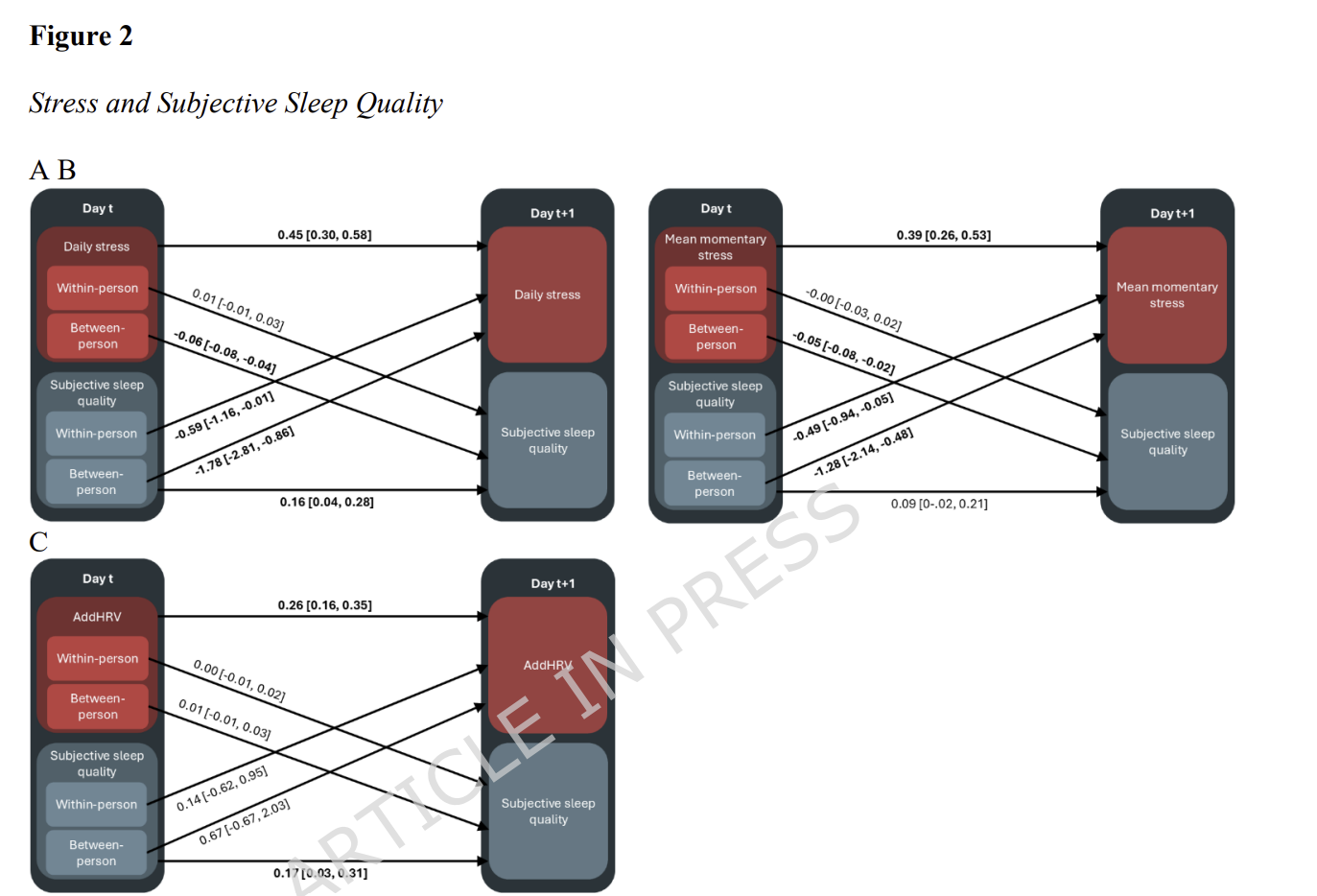
People who were more stressed in general tended to report worse sleep.
However, having a more stressful day than usual did not clearly lead to worse sleep that night.
Better-than-usual sleep was followed by lower stress the next day.
The relationship was much clearer when looking at how people felt about their sleep than when looking at measurements from the wearable sensors.
The researchers found little consistent connection between daily stress and objective measures such as total sleep time, sleep efficiency, or time spent awake during the night.
The way researchers defined a person's nighttime period changed some of the results. In one method, people with higher stress appeared to take longer to fall asleep, but this finding did not appear consistently when other methods were used.
The results stayed similar even after accounting for factors such as caffeine, alcohol, and nicotine use before bed.
Conclusion
The study suggests that the relationship between stress and sleep may be more complicated than simply saying more stress equals worse sleep.
People who generally experience more stress do tend to report worse sleep. But on a day-to-day level, the researchers did not find strong evidence that a stressful day automatically causes worse sleep that night.
Instead, the stronger pattern went in the other direction. When people slept better than they normally did, they tended to feel less stressed the following day.
The study also suggests the significance of methodology in research results. It's entirely possible that a person's experience of their sleep has discrepancies with what a wearable device measures, and it's important to work towards addressing these limitations to gain results of higher accuracy.