
Introduction
Test anxiety is a situation-specific type of stress that can take up mental space in your working memory, making it harder to focus and perform well, especially on important reading tests. While past research shows that anxiety is linked to slightly lower academic performance, it hasn’t been clear why this happens. In this study, researchers used a twin design to figure out whether the connection between test anxiety and reading scores comes from genetics, shared environments like school or home, or individual experiences. They focused on three parts of test anxiety: anxious thoughts, off-task behaviors, and physical reactions.
Methods
The study included 213 identical (monozygotic, MZ) twin pairs and 213 same-sex fraternal (dizygotic, DZ) twin pairs, with an average age of about 11.8 years. The group was ethnically diverse, and the twin type was confirmed using a parent questionnaire.
The children then took a Children’s Test Anxiety Scale (CTAS): A 30-question survey using a 4-point scale. measuring anxious thoughts (α = .91), off-task behaviors (α = .82), and physical autonomic reactions (α = .84). They also used a FCAT 2.0 Reading Test: A standardized reading exam with scores ranging from 100 to 500, known for high reliability (≈ .90–.92).
Analysis:
Researchers first looked at simple correlations between anxiety and reading scores. Then, they used a statistical model like Bivariate Cholesky decomposition to separate the effects into three parts:
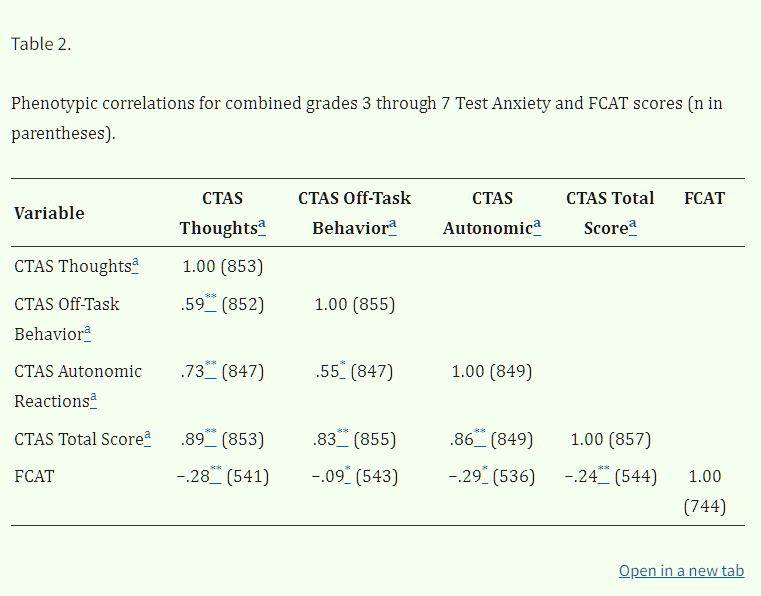
For Table 2, the decimals represent R values, i.e., how much of a correlation there is between two tests. For example, a low negative value, such as in CTAS thoughts compared to FCAT, indicates that there is some correlation that shows that children who score higher for the CTAS thoughts category of the test lead to their FCAT scores going down.
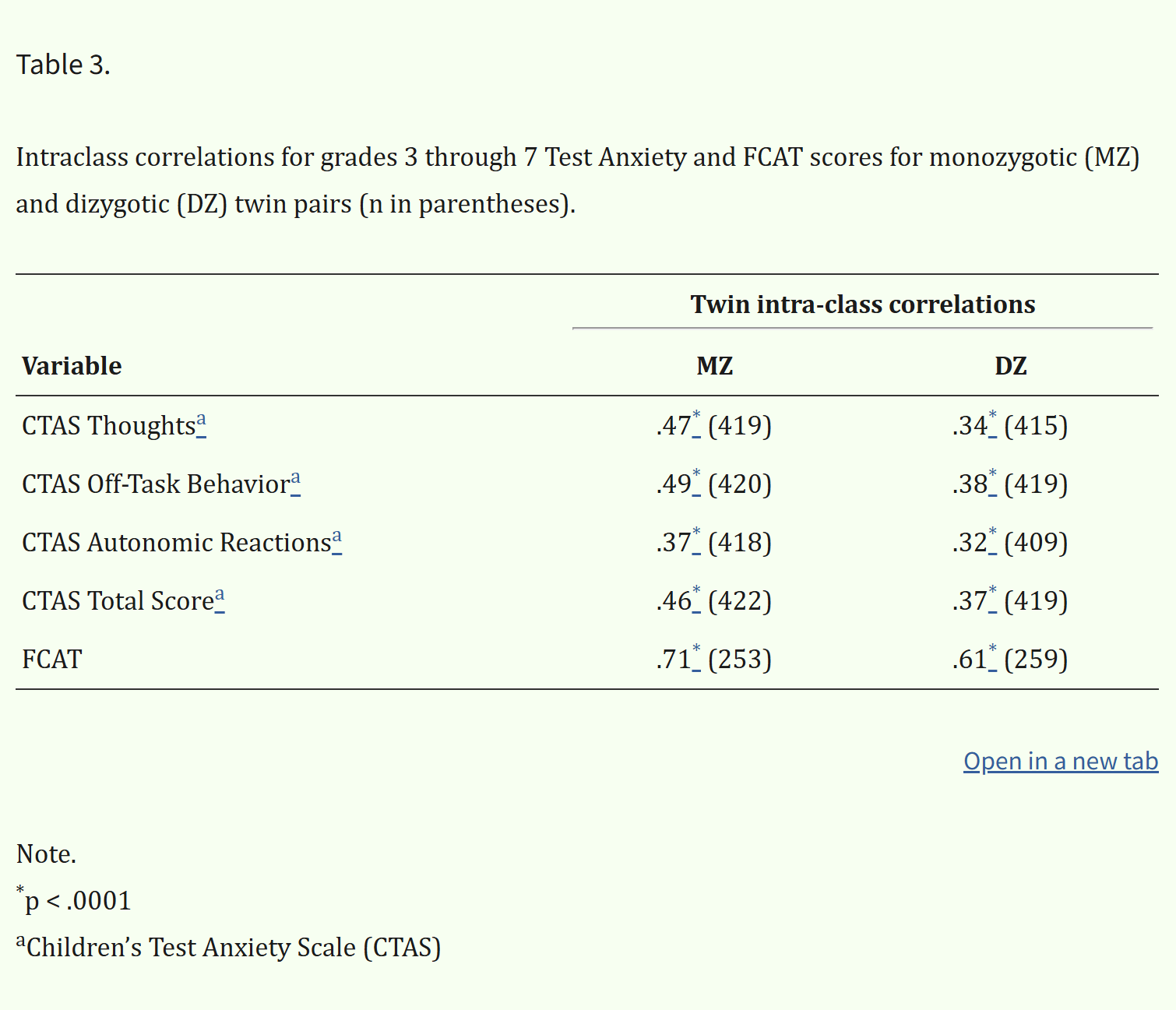
In Table 3, the decimals represent r values, with higher decimal values indicating that they are more similar (ex. 0.71 in the table shows that identical twins scored similarly for FCAT scores)
A (Additive genetics)
C (Shared environment) – things twins experience together, like school or family
E (Non-shared environment) – unique personal experiences
They also controlled for age, gender, and their interaction.
Results
All types of test anxiety were linked to lower reading scores:
Identical twins were more similar than fraternal twins in both anxiety and reading scores, showing that genetics does play a role overall.
However, when looking at why anxiety and reading scores are connected, the results were clear:
The shared environment (C) was the only factor explaining the overlap.
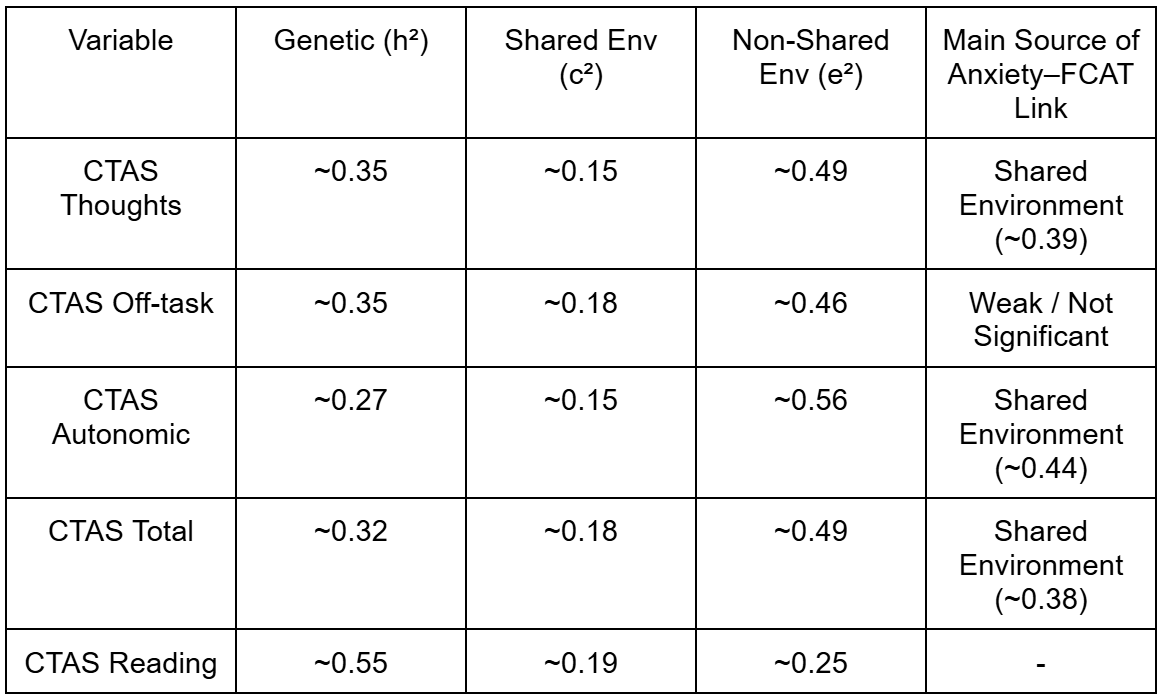
Genetics (A) and individual experiences (E) did not significantly explain the connection.
Off-task behavior didn’t show meaningful shared environment overlap, matching its weaker link to reading performance.
Conclusion
The link between test anxiety and lower reading scores isn’t due to genetics; it comes from shared environments, like classrooms, teaching styles, and testing conditions. This means schools can actually do something about it. By improving the testing environment, teaching better test-taking strategies, and reducing overall stress in school, educators can help break the cycle between anxiety and poor performance.