Introduction
Over the years, many scientists have attributed blue light to the rise of insomnia, low sleep duration, and poor sleep quality. However, the link between screens and sleep is much more complex than simply the color of light.
Methods
The study reviewed multiple studies, ranging from longitudinal to cross-sectional studies that showed the influence of technology on multiple aspects of sleep, such as the time it takes to fall asleep, disturbances in the circadian rhythm, and nightly interruptions.
Results
Bright Light Hypothesis
Several mechanisms are mentioned to affect sleep. For example, the bright light hypothesis, emerging in the 2010s, states that bright light in the evening can suppress the release of melatonin and create delays in the circadian rhythm. However, this effect occurs from both broad-spectrum white light and short-wavelength lights, like blue or green, that are contained within perceived white light. The effect of a bright screen was confirmed in a study that showed 5 hours of a bright laptop screen compared to a dim screen lessened the release of melatonin and caused pre-sleep alertness. This melatonin suppression has varied over time, with some studies stating it starts anywhere from 5, 2, or 1.5 hours after bright screen use.
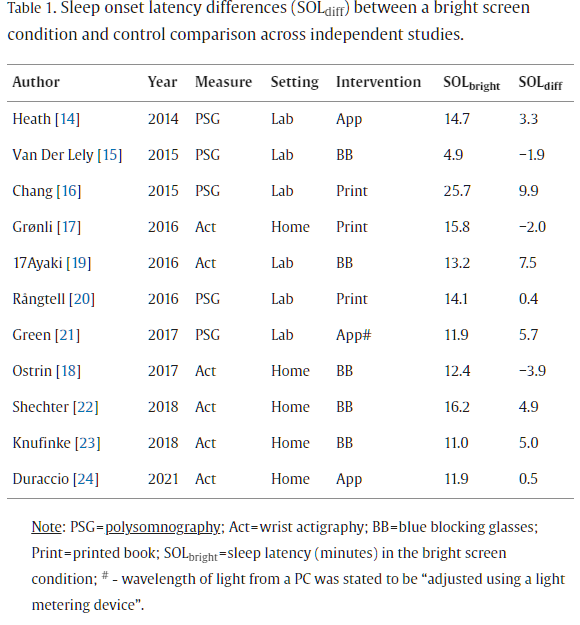
These studies also found that blue light barely affected sleep latency, usually only a difference of 1.9 minutes in single-night uses of blue light screens, and 9.9 minutes over 5 consecutive nights of blue light screen exposure. However, this sleep latency has varied widely in some studies, with a few studies having shorter mean sleep latency with brighter screens than control.
The table below shows the findings of multiple studies on sleep latency with a bright light (SOL bright) and the difference between a bright screen and the control group(SOL diff). different
Arousal Hypothesis
Another hypothesis to explain poor sleep is the arousal hypothesis, which states that media content on technology leads to elevated heart rates or brain activity that makes it harder to fall asleep. Studies testing violent video games, social media, and TV showed that there were no consistent findings, yet small increases in sleep latency for social media and video games. On the other hand, TV had little to no effect on sleep latency, with people actually falling asleep while watching TV. Other studies, such as those on different kinds of media, show some correlation with sleep latency(5-6 minutes), as does a study with preschoolers who reported fewer sleep problems after substituting educational content for violent content.
One outlier to mention is Dworak's study. Unlike other studies, which had participants engaging with their devices right before bed, they had participants engage in video games for one hour, 2-3 hours before bed, which created a 21.7-minute extension of sleep latency. However, overall evidence shows that the arousal hypothesis has a small to negligible influence on sleep in most cases.
In addition, technology may affect sleep quality through notifications. In a study of 10,000 adolescents, teenagers who left their phone ringer overnight were more likely to experience trouble falling asleep and staying asleep. Studies show that as this nighttime behavior turns into a habit, teenagers can have up to 3 times higher odds of falling asleep and 5 times higher odds of restless sleep. It also causes adolescents to engage with their phone, leading to upwards of 48 minutes of shorter sleep for those whose sleep was interrupted by cellphones. Large-scale mass media campaigns have attempted to promote healthy habits, such as keeping phones on Do Not Disturb or more than an arm's length away while sleeping, but their impact on sleep duration and quality still needs further study.
Sleep Displacement Hypothesis
The last hypothesis discussed is the idea of sleep displacement. Essentially, it was believed that time for sleeping was being replaced by time for technology. This is the leading cause for technology's effect on sleep latency. A study of 4010 adolescents found that time in bed met the recommendations for 8 hours, but they did not get 8 hours of sleep because of in-bed technology use. While other hypotheses usually have a delay of sleep onset of at best 10 minutes, sleep displacement theory delays sleep by upwards of one hour.
An important thing to note is the bi-directional links. Studies show that it works both ways; just as technology predicts sleep problems, sleep problems could potentially predict technology use.
However, there are several limiting factors to these hypotheses showing the negative effects of technology on sleep. Some evidence shows that the time spent on technology before sleep would still be spent awake rather than sleeping, showing how sleep may be a way to just pass time before people are ready to go to sleep. Additionally, adolescents who use technology to regulate negative emotions and anxiety could benefit negatively from having less screen time, proving that technology does not always harm sleep duration and quality.
Negative Moderators
Another important aspect is that the negative effects of technology may be reliant on "moderators": specific conditions based on the individuals that affect the relationship between technology and sleep. For example, a study found that compared to those without experience, gamers with experience did not have poorer sleep quality after playing violent games compared to non-violent ones. In addition, younger adolescents are prone to making less regulated decisions; in fact, how impulsive or risk-taking a teenager was was the most decisive factor in shorter sleep durations. Not only this, teenagers who self-reported that they were more likely to enter a "flow state" had up to 90 minutes more of a delay when going to bedtime compared to those who said they were less likely to enter a flow state.
Another factor was FOMO. A study of over 3000 adolescents directly correlated a higher FOMO with delayed sleep onset, short sleep duration, and poor sleep quality. Adolescents reported it was "embarrassing" to stop the conversation and did not want to miss out on conversations. That is to say, bedtime procrastination has also been shown to push back sleep, showing how sleep displacement is likely the largest factor in the negative effects of technology.
Protective Moderators
While addictive algorithms and tempting technological features make it hard, the ability to self-regulate technological use has been proven to reduce sleep displacement and preserve sleep duration and quality. Parent-set bedtimes and parental restrictions on devices have been shown to result in less time spent on devices, earlier bedtimes, longer time in bed, and increased total sleep time. On the contrary, a lack of media led to adolescents sleeping 40 minutes longer on school nights. It is also important to note that compliance is most probably a large factor in the duration of sleep and sleep quality.
Conclusion
As cell phone usage increases, it is hard for people to simply remove a phone from the bedroom to fix their sleep problems. While the studies in this review show how technology, especially right before bedtime, can harm sleep, new ways to mitigate the harm caused by devices must be implemented. While for some people removing a phone from the bedroom may help, mindfulness of the issue, not using devices beyond bedtime, and awareness of the addictive nature of screens can positively influence their sleep hygiene. While individual conditions vary, prioritizing mindful device boundaries ensures that technology helps rather than harms your sleep.