Introduction
With a rise in hostility and discrimination against homosexuals at the time of this study, an influx of both verbal and physical abuse against gay individuals with little motivation was shown. By some metrics, 90% of all homosexual individuals had experienced discrimination, with a third experiencing some form of physical violence. However, the reason for these deep moral biases was and still is not fully understood.
The meaning of homophobia has been defined as an emotional or affective response that an individual experiences interacting with homosexual individuals. The cause for homophobia itself is likely rooted in psychoanalysis, with the main theory at the time being an anxiety-based phenomenon. This theory explains that homophobia stems from anxiety about the possibility of being or becoming a homosexual. This likely is coupled with societal influences and views around traditional values, which would have been even more prevalent at the time of this study.
This study specifically was designed to investigate how homophobic and non homophobic men react to homosexual cues based on the psychological theory described above.
Methods
The sample size consisted of caucasian heterosexual male volunteers recruited from the University of Georgia. They were given a modified questionnaire to determine whether they considered themselves to be heterosexual or homosexual, as well as the Index of Homophobia to gauge whether they were homophobic or not. An aggression questionnaire was also provided to explore any tendencies the men might have. The heterosexual and homosexual scale had 25 items and divided the men into 4 groups, high and low grade homophobic and non homophobic men, where a higher score indicated a higher sense of "dread" felt when in contact with a homosexual. The results were used to split the men into homophobic and nonhomophobic groups for data analysis.The mean age of the men was 20.3 years.
A device was used to indicated arousal within men, where anatomical changes were measured via an apparatus that would indicate any responses to the given sexual stimuli. Changes were noted, and passed through an electrical column to detect and store as data.
The given stimuli were 4 minute segments of explicit content involving consensual adult heterosexual activity and both consensual male and female homosexual activity. The lesbian videotape was included in this stud as prior theories had shown it to be highly arousing to heterosexual men, making it an important metric to discriminate between homophobia and and aversion to gay men, which would support the anxiety hypothesis. It acted as an important contrast between heterosexual and homosexual male stimuli.
However, it is important to note the limitations here. The tested individuals are all self-reporting, with an index that is not totally comprehensive. The culture and other environmental differences of this one university could likely skew data mean to be indicative of a larger population. Furthermore, this study is quite dated. Being published 30 years ago, some of the methods, as well as societal and cultural normalities have changed drastically, which can change the application of the results. Furthermore, personal preferences and internal ideals may also influence the subjects in a personal way, which could also de-generalize the findings.
Results
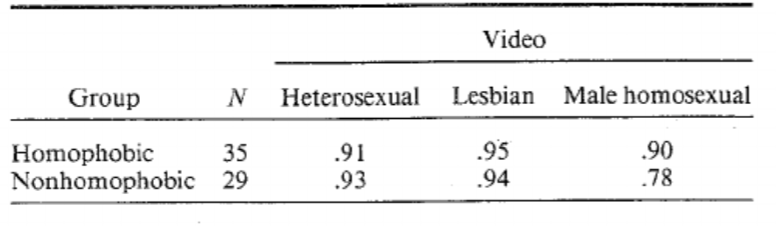
Shown above is a table illustrating a correlation between subject arousal and the subject ratings of physical signs of this arousal. A higher number indicates a higher physical shift, which in turn signals higher arousal. It shows similar results between the homophobic and nonhomophobic men in regards to both heterosexual and lesbian stimuli, but a greater biological response to male homosexual stimuli. There, the homophobic men saw a drastic different in stimulation. This further supports the anxiety hypothesis. Further psychoanalytical ideas theorize that an individual's own homosexual impulses cause repression, denial, or reaction formation. These varied explanations view homophobia as a simple type of latent homosexuality with high repression or unawareness.
Another hypothesis from 1983 describes a different role of anxiety, that viewing homosexual stimuli causes negative emotions in homophobic men, which could enhance arousal. This would explain the innate biological reaction demonstrated, and pin it on more of a threat condition than sexual arousal.
Another difficulty is again in defining homophobia, as well as measuring it. The metrics used in this study were highly cognitive and affective, and some suggest a bigger behavioral component should be used. Modification of the scales with further measure on the actual constitution of homophobia as an ideology could prove useful.
Conclusion
The findings here support the original anxiety hypothesis, whilst also branching off of the core belief that an innate homosexuality, whether the individual knows of it and represses it, or is unaware of it, leads to homophobia. Despite this, other theories also have validity, where anxiety acts as a stimuli itself for arousal, rather than the anxiety being the direct cause. Regardless, this study showed that homophobic men had higher arousal to homosexual male stimuli when compared to nonhomophobic men, whilst both groups had similar arousal to heterosexual and homosexual female stimuli. This has strong implications on the concept of homophobia and the intrinsic impact of it on a person and their psyche. Further studies should further look to define this concept whilst reaffirming the findings in this study.