Introduction
Immunoglobulins (Ig), also known as antibodies, are glycoproteins produced by plasma cells. Plasma cells help with humoral immune responses against bacteria, viruses, fungi, etc. There are five types of Ig with different functions and physicochemical properties: IgG, IgA, IgM, IgD, and IgE. The most important and abundant Ig in the human body is IgG. IgG is synthesized mostly in the secondary immune response to pathogens and is highly protective. From the four subgroups of IgG, IgG4 is widely regarded as an anti-inflammatory antibody.
IgG4-related disease (IgG4-RD) is a rare systemic disorder that involves the infiltration of IgG4+ plasma cells. It is associated with chronic pouch inflammation and concurrent autoimmune diseases. IgG4-RD affects various organs, especially the kidneys. The kidney parenchyma is a significant target in IgG4-RD, with plasma cell-rich tubulointerstitial nephritis (TIN) being the most common presentation of IgG4-related kidney disease. It correlates with low-grade proteinuria and progressive acute or chronic kidney failure.
Discussion
A 63-year-old man with a history of obesity, prediabetes, hypertension, hyperlipidemia, and fatty liver disease was referred to the nephrology clinic due to worsening kidney function and albuminuria. The patient also developed unexplained weight loss and systemic lymphadenopathy. A computed tomography (CT) scan found nodules in the right lung and bilateral iliac and retroperitoneal lymphadenopathy. A positron emission tomography (PET) scan revealed hypermetabolic lymph nodes, raising concerns for lymphoma (a type of blood cancer). The patient’s kidney function worsened based on creatinine increase from 1.24 mg/dl to 2.67 mg/dl, and the urine protein-creatinine ratio worsened from 190 mg/g to 313 mg/g. Serological workup was notable for low complement levels (C3 and C4), as well as a high IgG4 at 968 mg/dl (normal 2-96 mg/dl). A kidney biopsy revealed diffuse IgG4-positive plasma cell-rich tubulointerstitial inflammation.
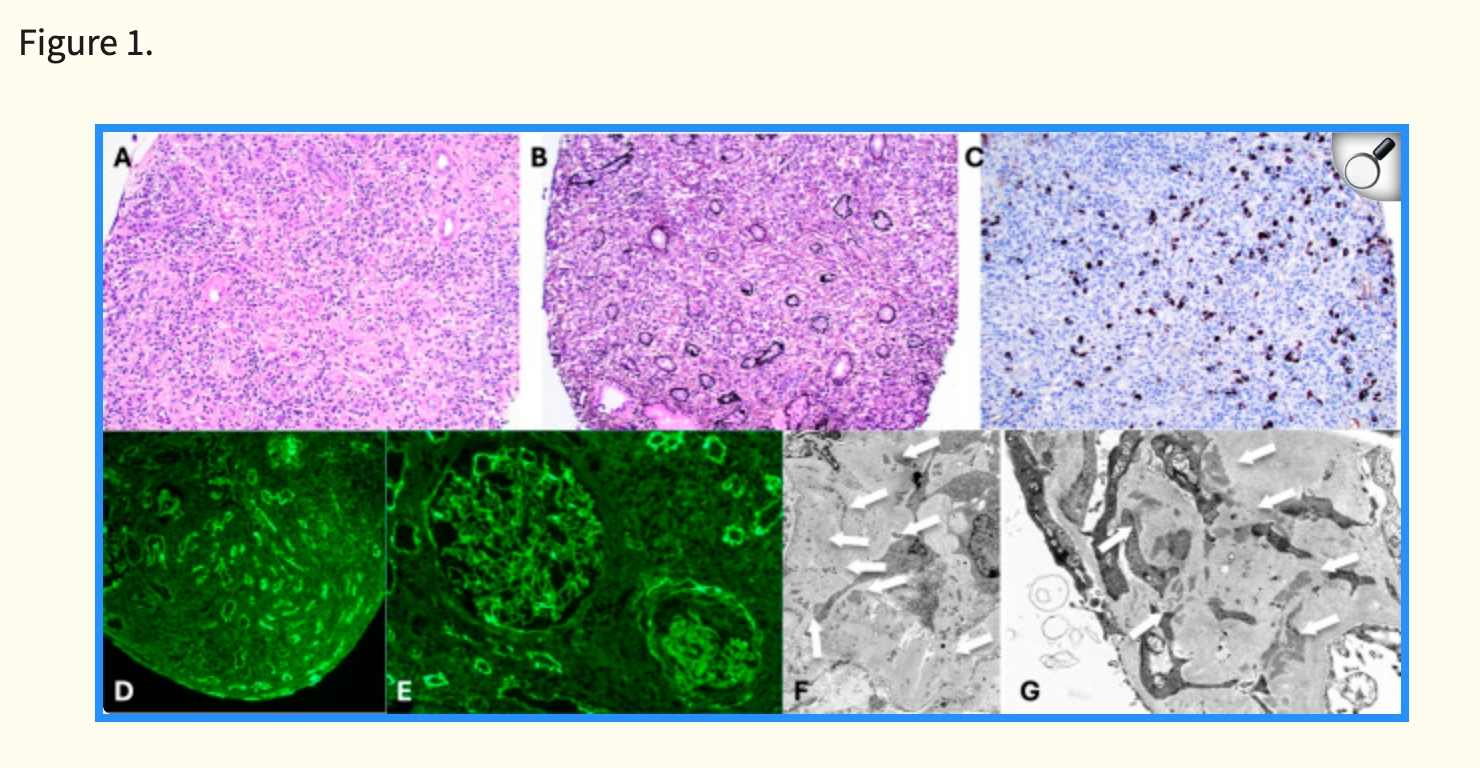
Based on clinical and histopathological features, a diagnosis of IgG4-RD was made. The patient was started on 30 mg prednisone daily for 4 weeks. The patient responded well to the treatment with improved creatinine, normalization of C3/C4 and IgG4 levels, and remission of lymphadenopathy. Prednisone was tapered over 3 months and stopped.
Glucocorticoids have a well-established efficacy for the treatment of IgG4-RD. Glucocorticoids remain the first-line treatment of IgG4-Rd. However, some patients relapse after glucocorticoids are tapered off. B-cell depletion with rituximab, a monoclonal anti-CD20, or newer agents, such as inebilizumab, are effective to prevent disease relapses in those patients.
Conclusion
IgG4-RD can develop with clinical and histopathological features of autoimmune disease and malignancies. Thus, it is challenging to make a timely diagnosis. Although an elevated serum IgG4 level can be associated with IgG4-Rd, it is neither sufficiently sensitive nor specific for diagnosis. The final diagnosis can only be made by biopsy. Additionally, diagnosis requires a high index of suspicion and careful evaluation of clinical, radiological, and laboratory data.