Introduction
Sugar substitutes are everywhere in today’s world. Many people choose drinks like Diet Coke or Sprite Zero in hopes of losing weight or cutting down the amount of calories they consume. But is replacing water with NNS beverages actually effective at helping people lose weight, or is it all just smoke and mirrors?
Methodology
208 participants aged 21 to 65 with a BMI of 27 to 40 were selected for the study; the study included both male and female participants and a diverse range of races and ethnicities. Researchers studied participants for one year, beginning with a 12-week weight-loss program known as The Colorado Weigh, followed by a 40-week weight maintenance period. Participants were split into two groups, one of which consumed NNS and the other of which consumed water solely. Participants of the NNS group drank 24 fluid ounces of NNS daily and were allowed to consume water freely afterward. Participants in the water group were instructed to drink at least 24 fluid ounces of water daily. Both groups tracked their water consumption on paper logs. Measurements of weight, blood pressure, and waist circumference were taken at 0 weeks (baseline), 12 weeks (after the weight-loss program), and 52 weeks (after the 40-week maintenance program). Questionnaires were also given out at 12, 24, 36, and 52 weeks to assess changes in perceived hunger.
Results
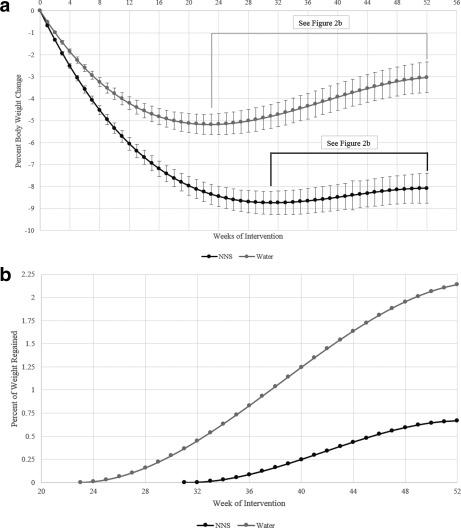
Figure 2.
The NNS group experienced a significantly higher percent change in body mass following the 12-week weight-loss period. Furthermore, the NNS group experienced less weight rebound during the weight management period. In general, more people in the NNS group saw long-lasting weight changes.
Conclusion
In conclusion, the study shows that drinking NNS beverages rather than water significantly helped participants lose weight and keep it. However, there are some limitations to the findings. The researchers were unable to determine why NNS was noticeably more effective than water. Furthermore, the presence of confounding factors is very possible. Some obvious confounding factors were mitigated in the initial screening process; for instance, only people who did not frequently partake in intense exercise were considered for the study. Furthermore, the study shows weight loss results following a specialized program; the same effects may not carry over to an average person consuming NNS.
Although NNS beverages show potential to revolutionize weight-loss methods, more research is needed to clarify the mechanisms underlying their effects and to confirm their effectiveness in the general population.